
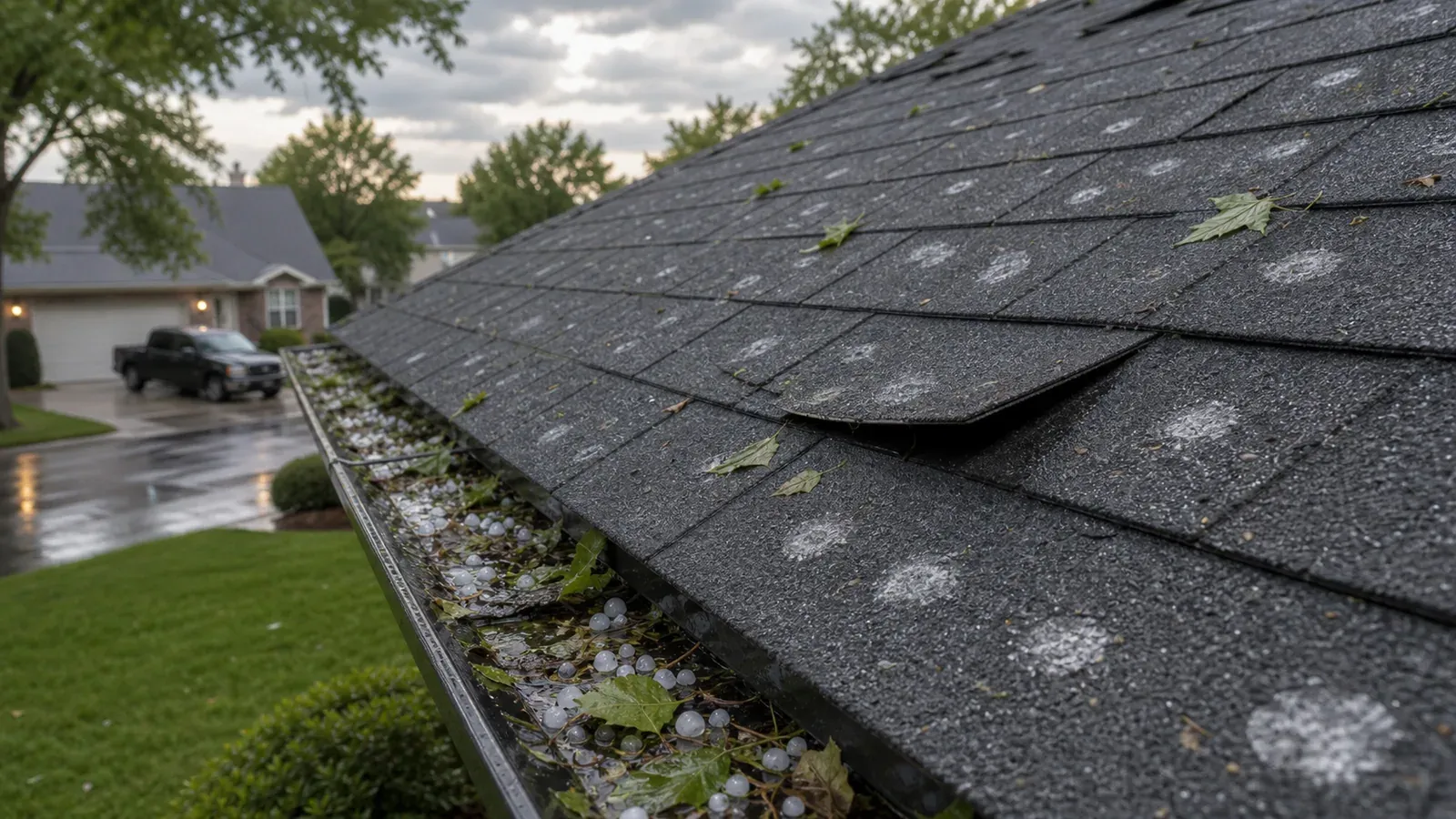
What Hail and Wind Can Do to Your Roof
Published July 4, 2026
If a storm just hit: stay off the roof, photograph any interior leaks and ceiling stains, tarp only what you can reach safely from a ladder’s height (or call us to tarp it), and get a professional inspection before filing anything with your insurer. Documentation order matters more than speed.
Charlotte’s storm profile: what actually hits our roofs
Charlotte’s roofs face a specific, repeating set of threats:
- Spring hail (March–June). The Piedmont sits in a genuine hail corridor. Supercells tracking along the I-85 spine drop quarter-to-golf-ball hail somewhere in Mecklenburg County most years — and a damaging multi-neighborhood event every few years.
- Summer downbursts. Thunderstorm straight-line winds regularly gust past 60 mph, breaking shingle seals and lifting tabs — damage that doesn’t leak until months later.
- Hurricane remnants (August–October). Charlotte is far enough inland to miss the worst surge-and-eyewall damage, but remnants like Hugo’s famous 1989 visit remind us: sustained tropical wind plus saturated ground equals downed trees and limb-punctured roofs.
- Tree canopy. Charlotte’s oaks and pines are the city’s signature — and every major storm sends limbs onto roofs. Impact damage can crack decking even when shingles look intact.
- Occasional ice. A winter ice storm every few years stresses flashing, gutters, and overhanging limbs.
How to check for damage after a storm (safely)
From the ground, look for:
- Shingles or shingle pieces in the yard
- Dents in gutters, downspouts, and the AC unit’s fins — soft metal records hail your shingles also took
- Granules piling in downspout splash areas — heavy loss after a storm indicates hail scouring
- Lifted or creased shingle tabs visible along roof edges
- Damaged window screens, dented mailboxes, stripped tree foliage — all corroborate hail size
Inside the attic: water staining on decking, daylight through boards, damp insulation.
What you can’t see from the ground: hail bruising. A bruised shingle looks fine from thirty feet but has lost the granule bed protecting its asphalt — it will fail years early. This is what a professional inspection with photos documents, and it’s exactly what insurance adjusters need to see. A free post-storm inspection settles what’s cosmetic and what’s a claim.
The insurance claim process in North Carolina, step by step
- Document before you file. Get an inspection with photo documentation of every elevation, slope, and soft-metal hit. Filing first and inspecting second is how claims get minimized.
- Review your policy. Note your wind/hail deductible — many NC policies carry a separate percentage deductible (1–2% of dwelling coverage) for wind and hail rather than your flat deductible.
- File promptly. NC policies require prompt notice; a year is a common outer limit and some policies specify less. Hail damage doesn’t improve with age — and neither does a claim’s credibility.
- Meet the adjuster with your contractor present. This is the single highest-leverage step. The adjuster walks the roof once; your contractor makes sure every strike, crease, and collateral hit is on the record.
- Review the scope of loss. The insurer’s estimate itemizes what they’ll pay. A legitimate local contractor works from that scope, flags anything missed, and requests supplements for real omissions — not invented ones.
- Understand ACV vs. RCV. Replacement-cost (RCV) policies pay in two stages: actual cash value first, then recoverable depreciation after the work is done. Budget accordingly.
The deductible rule that protects you
In North Carolina, a contractor offering to “waive” or “absorb” your deductible is committing insurance fraud — and homeowners who sign onto it are exposed too. This is the calling card of post-storm chasers. So is the pressure to sign a contingency agreement at your door before any inspection exists. The full red-flag list is in our guide to choosing a Charlotte roofing company; the short version is that anyone rushing your signature after a storm is not on your side.
Repair, restore, or upgrade?
Storm claims are also decision points. If insurance is replacing the roof anyway, the incremental cost of upgrading matters:
- Impact-resistant (Class 4) shingles cost modestly more and may earn premium discounts with some NC carriers — ask your agent.
- Metal roofing turns a hail-prone roof into a non-issue for decades. If you’ve filed two hail claims in ten years, read our Charlotte metal roofing guide before deciding on like-for-like shingles.
- If damage is localized and the roof is young, an honest repair plus a documented inspection may be the right answer — not every storm means replacement. Our repair vs. replacement guide lays out the framework.
After the storm checklist
- Photograph interior damage immediately (timestamped phone photos are fine)
- Ground-level exterior check: gutters, AC fins, screens, yard debris
- Schedule a professional inspection with photo documentation
- Review policy: wind/hail deductible, ACV vs. RCV
- File the claim with documentation in hand
- Have your contractor meet the adjuster on the roof
- Choose your contractor on merit — never from a door knock
Storm damage is stressful, but the process is manageable with the steps in order. If a storm’s just been through your neighborhood, call for a free inspection — you’ll know within a day whether you have a claim or just a story.